
217 Gallons at Noon: What a Rusted Water Heater Taught Us About Early Alerts
Monday, October 26, 2026
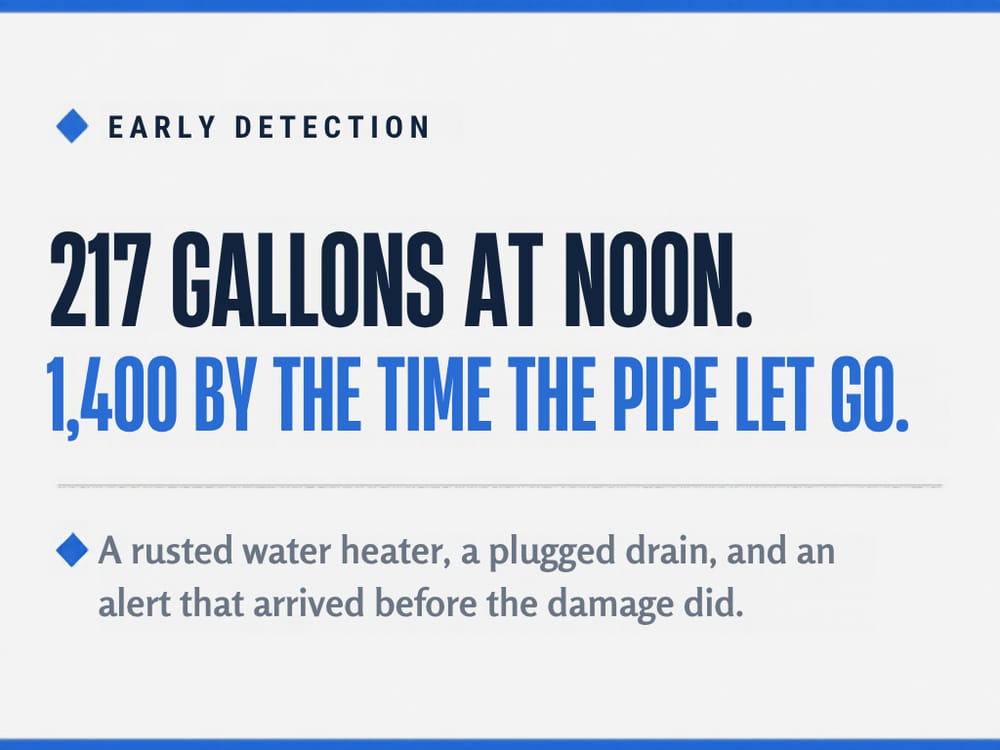
217 gallons at noon. Not too bad.
Then 290. Then 500. Then the pipe broke all the way open, and the building was running 1,400 gallons.
That is the hourly data from a small commercial property, and it shows what a leak looks like while it is still building.
The Property
This was a small commercial property. Our co-founder, Dan Prescott, described how the people there use water: "They just use sinks and people wash their hands and maybe cook a little lunch in the office. They don't use a lot of water."
Their normal consumption is about 225 gallons a day. That is the whole day, for the whole building.
What Dan Said Before He Showed the Chart
Before he pulled up the data, Dan described how leaks tend to start at properties this size: "You'll have a little pinhole leak and you'll start seeing water just run continually. With visibility into that, we can catch that before it turns into a catastrophic issue."
He said the leak in this example "started out really slow and then over a number of hours it ramped up. It's just kind of this slow up and to the right."
The Day It Changed
On the day of the leak, the property used about 10 times its normal amount. Dan noted this was older data, and when you drill down to the hourly numbers, the story is clear: 217 gallons at noon, then 290, then 500, and then 1,400.
Look at what those numbers mean for a building that normally uses 225 gallons in a day. At noon, a single hour was already running nearly a full day's normal use. By the end, one hour was more than six times that.
Dan has a way of describing a chart like that. He said it "almost looks like a really good financial chart. The financials are great, except we're talking about water and it's the wrong way."
The Source
The leak came from a hot water heater in the utility room on the lower level of the building. It had rusted out. And the drain down there was partially plugged, which meant the water had somewhere to collect instead of somewhere to go.
What the Alert Changed
When the alert went out, the staff "dropped everything, went down and looked and it was already starting to build a pool in the basement."
They shut the water off and got it fixed.
Dan said they were "obviously very grateful that they didn't have any property damage. They got everything dried out quickly and just saved a lot of issues."
He added that with the Ethernet connection, the same data can be viewed at the minute level, not just by the hour.
Why the Alert Has to Be Understood
An alert only helps if someone acts on it. Dan has watched customers see a continuous water use alert measured in gallons, acknowledge it, and go on with their day. Gallons are not how people think about water. What people know is their bill. As Dan put it, "I know that my bill for my water company was $100 last month and I'm going to be livid calling the utility if it's ever more than $110."
So PhantomH2O takes the utility's rates, ties them to the consumption coming off the meter, and puts dollars and cents right below the alert. The alert speaks in the language people already understand.
Why Small Leaks Matter
It is easy to believe that a small leak is a small problem you can deal with later. This one was at 217 gallons an hour at noon, and it kept climbing until the pipe let go.
Dan describes water as the biggest property damage risk a building has. This story is that risk in action: a rusted heater, a plugged drain, and a utility room filling up. But the same visibility that protects against damage also protects against cost, because water loss can run quietly without damaging anything and still add up.
The question is whether you find out before it becomes expensive or causes damage to the property.
The difference in this story was not the repair. It was when someone found out.
Where to Start
If you want to see what that kind of early visibility looks like for your own properties, you can book a call here.