
80% of Wasted Water Never Touches a Sensor
Monday, October 05, 2026
Scientific projections said Colorado would be out of water by 2025.
That did not happen. But the underlying reality those projections pointed to has not changed. Water stress is real, it is accelerating, and it is showing up in places most people did not expect it to show up this soon.
I was in Las Vegas recently. Las Vegas sits on Lake Mead, a reservoir that has been at what water engineers call deadpool-level reserves. Deadpool is not a metaphor. It is the actual technical term for when a reservoir drops so low it can no longer generate power or supply water downstream. Lake Mead powers approximately a quarter of the country.
Most people hear that and file it under "someone else's problem." It is not.
What the engineer who built the system says
I had a conversation with our CTO, Dan. Dan built the monitoring software infrastructure that municipal water utilities across the country run on. When I asked him how he thinks about the larger water picture, he did not hedge.
"Water is the single most needed resource on the planet. I can live 40 days without food. I can live without energy. Three days without water and you're done. Growth stops without water."
No pitch. No hyperbole. Just reality, stated plainly by someone who has spent his career at the infrastructure level of how water actually moves.
Then he said something that reframed the entire conversation for me.
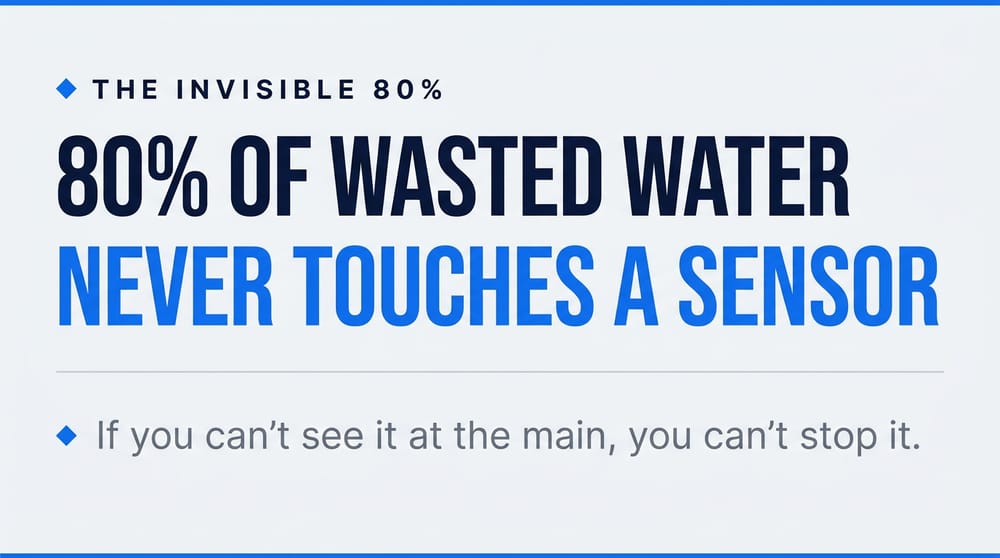
"80% of wasted water runs down the pipe. It's never going to touch an edge sensor."
That is the insight most property managers have never been given.
The gap in how most buildings approach water
If a property has sensors on fixtures but no visibility at the main line, it is watching a handful of specific points while the majority of its cost risk stays completely invisible.
You do not know what is coming into the building. You do not know what is leaving. If there is a slow leak running continuously between floors, it is not showing up on a fixture sensor. It is running. Every hour. Every day. Until someone notices something wrong, or until the bill arrives and the number does not make sense.
That is not a conservation strategy. That is guessing.
The main line is where everything starts. It is where you establish the baseline. It is where you find out what is actually happening before you decide where going deeper into risers, utility closets, or individual units will make a difference. Without that starting point, even the best intentions produce no results.
The bigger picture and the property-level reality
The scarcity Dan describes is real. It just has not hit most properties yet in the way it hits a city that loses its reservoir.
But here is what is already happening at the property level, right now, in buildings across the country. Water is likely the largest uncontrolled operating expense on most multifamily properties. It moves through the building 24 hours a day. It spikes, leaks, and runs. Unless someone happens to notice something and says something, the property has no idea.
The properties that are starting to get control of their water spend are not the ones with the best conservation messaging. They are the ones that started at the main line, established a baseline, and let the data tell them where the problems actually were.
That is the approach. It is not complicated. But it requires visibility, and most buildings do not have it yet.
Where to start
If you manage a multifamily property and you have been wondering whether your building is wasting water, or you already know it is and are not sure where to start, the first step is a conversation.
We look at your property, ask the right questions, and help you understand what is actually happening before recommending anything.
Schedule a free discovery call
P.S. Dan's stated goal is to positively impact a billion people in his lifetime. He said PhantomH2O is one way to do it. I do not say that to sound grand. I say it because the people who built this system actually care about water, and that comes through in how it works.