
Two Ignored Alerts, and the $31,000 They Cost
Monday, October 19, 2026
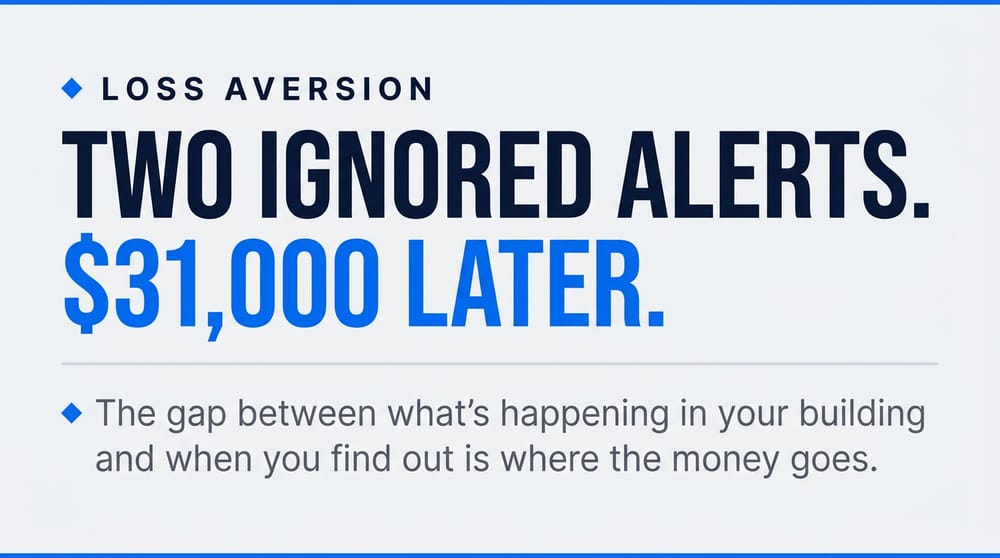
One of our early clients got an alert.
Their water use was up. Something had changed inside the building. We reached out and said, "You're using more water than normal. What's going on?"
Their response: "We don't think it's that big of a deal. We'll let it go."
Okay. Fine. We kept watching.
What happened the first month
A month later, their bill came in $10,000 higher than it had ever been.
We called again. We walked them through the numbers and explained what we were seeing at the main line. The answer was the same. "We're not going to worry about it."
That is not a criticism. Most people react this way. A water alert is a prediction, and a bill is a fact. Until the fact arrives, the prediction is easy to wave off.
What happened the second month
Another month passed. Another $11,500 on top of the $10,000 they were already up.
Two months. Two rounds of alerts. Two rounds of conversations where we showed them exactly what was happening. When it was over, they had spent more than $31,000 above what they should have, on little leaks and an irrigation issue that nobody investigated because nobody believed it was real.
Until the bills proved it.
The side of the math people skip
Here's the part I keep coming back to. Dan said something in a recent meeting that stuck with me.
We spend a lot of time talking about what you will save with PhantomH2O, and the savings are real. One of our current clients is netting nearly $2,000 a month after monitoring costs, with more than $25,000 saved over 13 months.
But there is another side that most people underestimate. It is not just about the gain. It is about what you are silently losing right now, and the fact that you will not find out until 30, 60, sometimes 90 days after it has already happened.
Behavioral economists call this loss aversion. People feel the pain of losing a dollar far more strongly than the pleasure of gaining two. The benefit is real. So is the cost.
What you are really paying for
Somewhere in your building right now, water is moving. You do not know exactly where, and you do not know exactly how much. Your next bill, not the one after that, is going to tell you what has been happening while you were not watching.
That gap, between what is happening and when you find out, is what PhantomH2O closes. Not after the damage. Not after the $31,000. Now.
Start with a conversation
If you want to understand what is actually moving through your building and what it is costing you, the first step is a free 30-minute property discovery call. It is a conversation, not a pitch. No obligation, no pressure, just clarity on whether monitoring fits your property and what your exposure looks like today.
[Schedule your free 30-minute property discovery call]